 Babak Goshayeshi
Doctoral research · Institute for Clean & Secure Energy · University of Utah
Two-Phase One-Dimensional Turbulence Model
Simulating the combustion of a single coal particle in laminar flow with fully detailed chemistry, resolving gas-phase kinetics, devolatilization, and char oxidation at a computational cost far below full 3-D direct numerical simulation.
The result
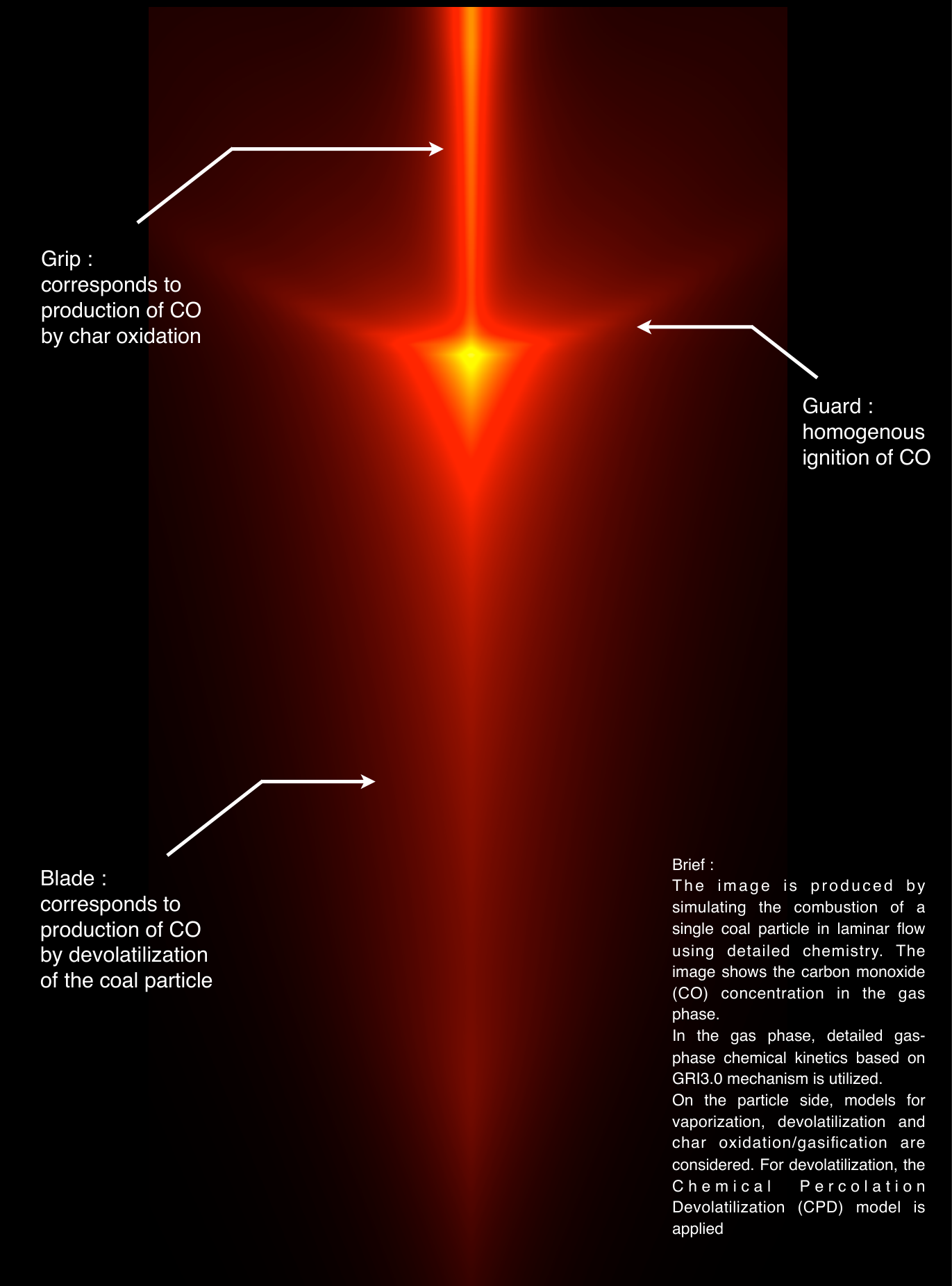
The “CO Excalibur”
Carbon monoxide concentration in the gas phase around a single burning coal particle, resolved in space (horizontal) and time (vertical, top to bottom). The structure of the CO field traces the physics, each part of the “sword” corresponds to a distinct combustion mechanism.
Grip char oxidation
The narrow early-time streak corresponds to production of CO by heterogeneous char oxidation at the particle surface.
Guard homogeneous ignition
The bright cross-piece marks the homogeneous ignition of CO in the gas phase, the moment the accumulated CO ignites.
Blade devolatilization
The long tail corresponds to production of CO by devolatilization of the coal particle as it heats and releases volatiles.
The model
Two coupled phases
The ODT model resolves the full range of length and time scales along a single line of sight, coupling a fully resolved gas phase to Lagrangian coal particles.
Gas phase
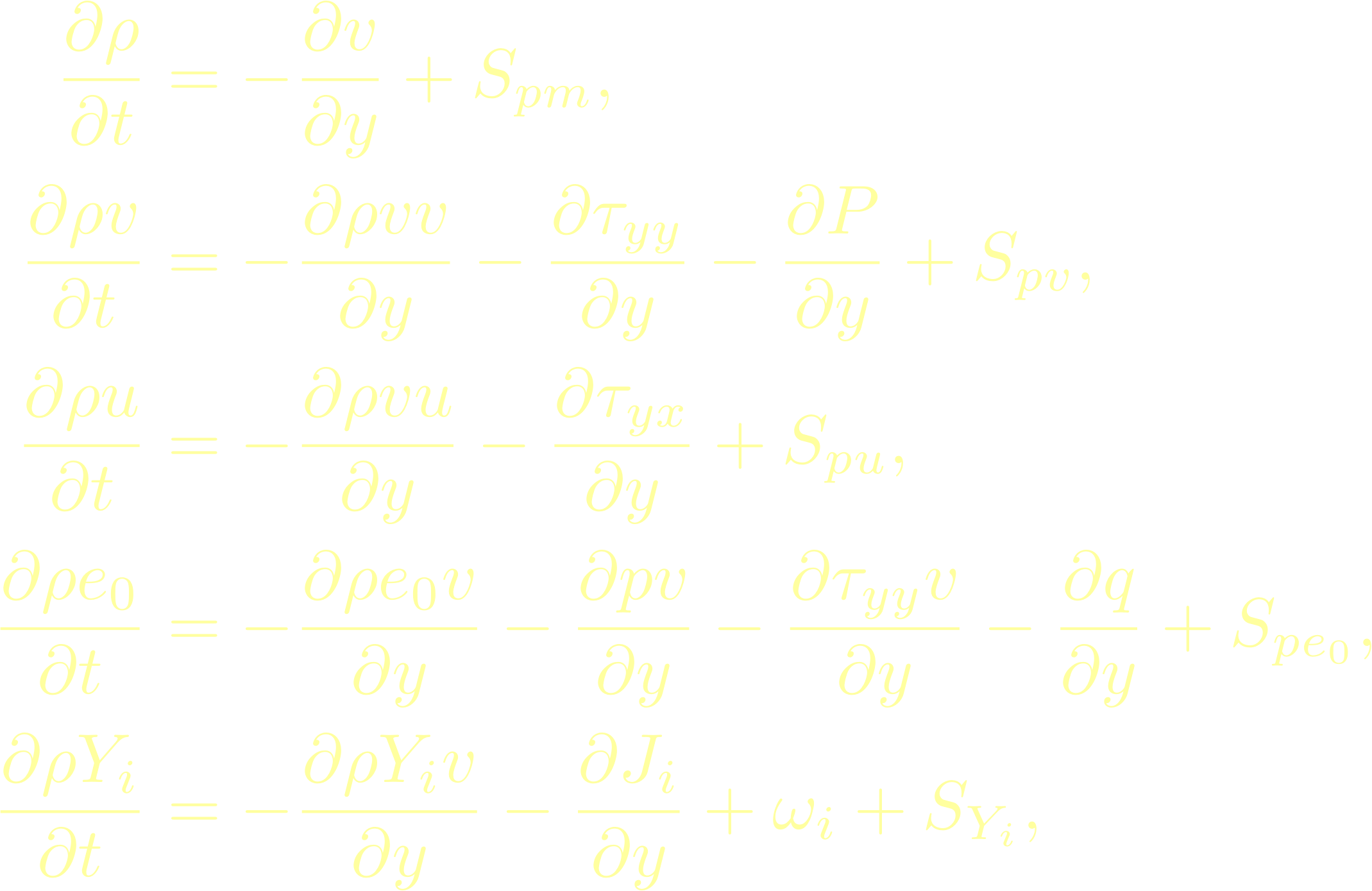
Conservation of mass, momentum, energy, and species are solved on the ODT line, with source terms coupling the gas to the particle phase.
Coal particle
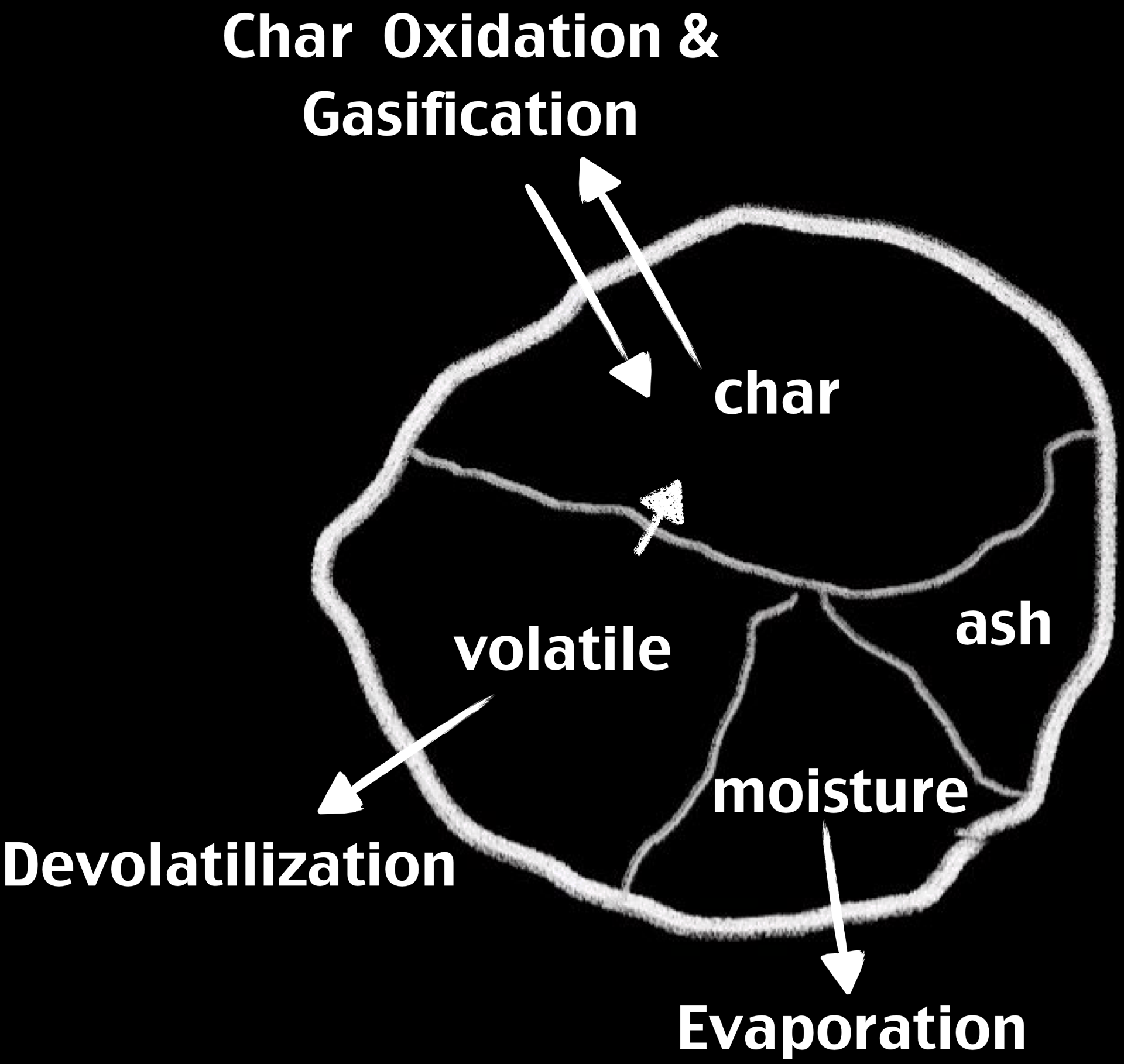
Each particle carries submodels for evaporation, devolatilization (CPD), and char oxidation/gasification, exchanging mass, momentum, and heat with the gas.